The
selection of GRP material for sea water intakes and discharge
applications offers many advantages connected to the material
characteristics: GRP pipe is fully resistant to corrosion. The following
methods are used for offshore GRP pipeline installations:
- Towing method
- Bottom pulling method
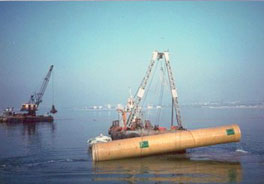
- Installation by crane barge
Towing method
The pipeline string is prepared on-shore, then
launched at sea by the pulling method but at a certain elevation on
the sea bed, where it is maintained and finally towed to the
installation place. Spare buoys are generally used to limit the
amount of surface motion transferred to the pipeline.
Bottom Pulling Method
This method is implemented by assembling on-shore
strings of GRP pipe and by pulling them along the designed route
axis trough a winch-cable system operated from a terminal located on
barge.
The use of this technique implies the availability of an on-shore
leveled area, where it is possible to pre-assemble flanked long
strings of GRP pipe.
Strings are launched in sequence by transferring each string on the
launch line. GRP pipeline is pulled through a winch-cable system,
hooked to a pulling head, connected to the source of the first
string. Once a GRP pipe string has been launched, next string is
transferred on the towing line and connected to the previous one.
Joining operations are implemented on-shore.
This method allows the contemporary launching of more than one
parallel pipeline. Pipes may be launched empty, flooded or lightened
by means of floats. Pipeline may advance directly on the seabed
previously prepared or inside a pre-excavated submarine trench.
Crane Barge
This is probably the most used method nowadays,
especially for large diameter pipes. The semi-mobile or towed barge
has to have suitable dimensions in order to contain all equipment
required for stowing and joining pipe lengths. The barge dimensions,
in addition to joining and launch operations, affects the progress
of the work. Each pipe length is raised by the barge crane and
lowered into to sea, where it is laid on the prepared seabed near
the already laid pipe length. The connection of pipe lengths is
performed by skilled divers by means of hydraulic jacks, which can
be applied to collars mounted on the pipe ends.
|